Chaos Mode: Cross-Model Concurrent Throughput Maximization
Related:
- Model Routing - Core model selection and tier management
- Z.ai Knowledge Base - Provider-specific rate limit behavior
- Model Concurrency Findings - Empirical concurrency test results
- Metrics Reference - Related Prometheus metrics
Dashboard Visualization
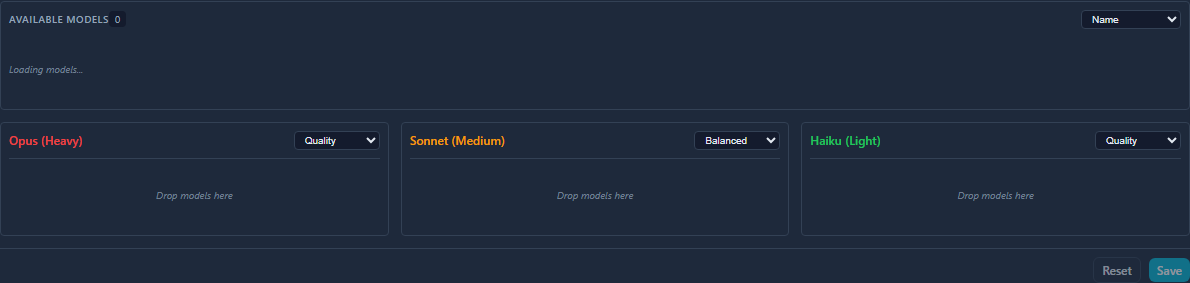
The Model Routing page shows available models and their configurations:
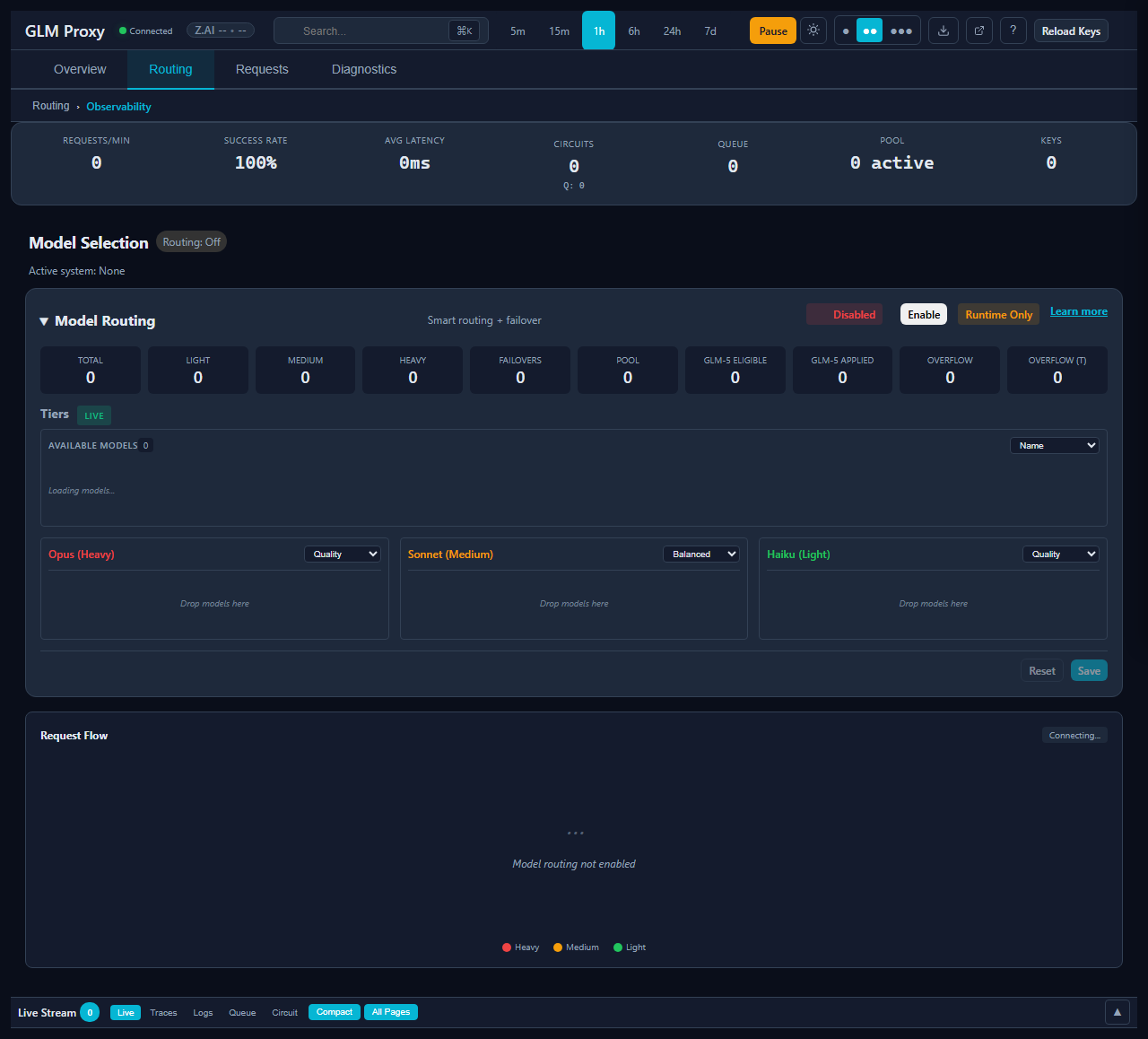
Model List - View all available models with their tier classifications:
Problem Statement
Context: See Model Concurrency Findings for empirical test results showing that concurrency is per-account, not per-key on Z.ai.
With z.ai’s per-model concurrency limits, a single model bottlenecks at its limit (e.g., glm-4.7 at 3 concurrent). When running parallel Claude Code agents (oh-my-claudecode’s ultrawork/swarm modes), requests queue behind the same model’s rate limit even though other models have spare capacity.
Chaos mode distributes requests across ALL available GLM models to maximize aggregate concurrent throughput, treating the entire z.ai model catalog as a single pool rather than routing everything to one model per tier.
Rate Limit Reference (z.ai Subscription)
Source: Z.ai Coding Subscription for detailed tier limits and quotas. Note: Concurrency values below reflect empirical findings from Model Concurrency Findings, not advertised limits.
| Model | Concurrent | Tier | Cost (in/out per 1M) |
|---|---|---|---|
| glm-4.7 | 3 | HEAVY | $0.60 / $2.20 |
| glm-4.6 | 3 | HEAVY | $0.60 / $2.20 |
| glm-4.5-x | 2 | HEAVY | $2.20 / $8.90 |
| glm-4.5 | 10 | MEDIUM | $0.60 / $2.20 |
| glm-4.5-air | 5 | MEDIUM | $0.20 / $1.10 |
| glm-4.7-flashx | 3 | LIGHT | $0.07 / $0.40 |
| glm-4.7-flash | 1 | LIGHT | FREE |
| glm-4.5-flash | 1 | LIGHT | FREE |
Max aggregate concurrency: 28 simultaneous requests (all models combined)
Design Principles
- Opt-in — Chaos mode is a config flag, default off. Existing behavior unchanged.
- Quality floor — Users set a minimum tier. Chaos never routes Opus requests to flash models.
- Concurrency-aware — Prefer models with available capacity, not just round-robin.
- Existing infrastructure — Build on
ModelRouter,KeyManager._modelPools, and per-model cooldown tracking. - Observable — Dashboard shows which models are active, per-model utilization, chaos mode status.
Architecture
Config Shape
// In config.modelRouting:
chaosMode: {
    enabled: false,

    // Minimum quality floor per incoming tier
    // Controls which models are eligible for each request type
    qualityFloor: {
        heavy: 'HEAVY',     // Opus requests → only HEAVY models (4.7, 4.6, 4.5-x)
        medium: 'MEDIUM',   // Sonnet requests → HEAVY + MEDIUM models
        light: 'LIGHT'      // Haiku requests → all models including flash
    },

    // Strategy for selecting next model from eligible pool
    strategy: 'least-loaded',  // 'least-loaded' | 'round-robin' | 'weighted-random'

    // Models explicitly excluded from chaos rotation
    excludeModels: [],    // e.g., ['glm-4.5-x'] to avoid expensive model

    // Cost guard: max $/request before downgrading model selection
    maxCostPerRequest: null,  // null = no limit, e.g., 0.05

    // Whether to include free-tier models (may have lower quality)
    includeFreeModels: true,

    // Sticky sessions: keep same model for multi-turn conversations
    stickyConversations: false
}
Model Pool Manager (new class)
File: lib/chaos-pool.js

class ChaosPool {
    constructor(config, modelDiscovery) {
        this.models = [];           // Available models with metadata
        this.inFlight = new Map();  // model -> current in-flight count
        this.roundRobinIndex = 0;
        this.totalDispatched = 0;
    }

    // Core method: pick next model for a request
    selectModel(requestTier, attemptedModels) → { model, reason }

    // Track model usage
    acquire(model) → void
    release(model) → void

    // Get pool status for dashboard
    getStatus() → { models: [...], totalCapacity, usedCapacity }
}
Selection Strategies
1. least-loaded (recommended default)
Picks the model with the most available capacity relative to its limit.
score(model) = (maxConcurrency - inFlight) / maxConcurrency
Ties broken by: lower cost → higher maxConcurrency → round-robin.
Example with 5 parallel requests:
Request 1 → glm-4.5 (10 slots, 0 used, score=1.0)
Request 2 → glm-4.5 (10 slots, 1 used, score=0.9)
Request 3 → glm-4.5-air (5 slots, 0 used, score=1.0)  ← tied, lower cost wins
Request 4 → glm-4.5 (10 slots, 2 used, score=0.8)
Request 5 → glm-4.7 (3 slots, 0 used, score=1.0)       ← if tier allows
2. round-robin
Strict rotation through eligible models. Simple, predictable. Ignores current load.
models = [glm-4.5, glm-4.5-air, glm-4.7, glm-4.6, ...]
Request N → models[N % models.length]
Skip if at capacity → next model
3. weighted-random
Probabilistic selection weighted by available capacity.
weight(model) = max(0, maxConcurrency - inFlight)
P(model) = weight(model) / sum(all weights)
Integration Points
1. ModelRouter.selectModel() (modify)
// In lib/model-router.js, _selectModelInternal():

if (this.config.chaosMode?.enabled) {
    return this.chaosPool.selectModel(
        classifiedTier,      // from existing classifier
        attemptedModels,     // from retry loop
        { requestModel, parsedBody }
    );
}

// ... existing tier-based logic (unchanged when chaos disabled)
2. RequestHandler retry loop (no changes needed)
The existing attemptedModels Set and modelSwitchCount already handle the case where a model fails — chaos pool respects both via its selectModel(requestTier, attemptedModels) signature.
3. KeyManager._modelPools (read-only integration)
ChaosPool reads _modelPools for real-time cooldown state but doesn’t modify it. Existing pool cooldown, burst dampening, and account-level detection continue working.
// ChaosPool checks before selecting:
const cooldownMs = keyManager.getModelPoolCooldown(model);
if (cooldownMs > 0) skip;  // Model is cooling down from 429
4. StatsAggregator (enhance)
Add chaos mode metrics:
chaosStats: {
    enabled: true,
    strategy: 'least-loaded',
    modelDistribution: {
        'glm-4.7': { dispatched: 15, inFlight: 2, capacity: 3 },
        'glm-4.5': { dispatched: 45, inFlight: 8, capacity: 10 },
        // ...
    },
    totalCapacity: 28,
    currentUtilization: 0.71,   // 20/28
    avgQueueWait: 42            // ms
}
5. Dashboard (new panel section)
In the routing page, show chaos mode status:
┌─ Chaos Mode ─────────────────────────────────────┐
│ Strategy: least-loaded    Utilization: 71% (20/28)│
│                                                    │
│ Model          In-Flight  Capacity  Cooldown       │
│ glm-4.7        ██░        2/3       -              │
│ glm-4.6        █░░        1/3       -              │
│ glm-4.5        ████████░░ 8/10      -              │
│ glm-4.5-air    ███░░      3/5       -              │
│ glm-4.7-flashx ██░        2/3       -              │
│ glm-4.7-flash  █          1/1       -              │
│ glm-4.5-flash  ░          0/1       429 (3.2s)     │
└────────────────────────────────────────────────────┘
Implementation Plan
Phase 1: ChaosPool Core (lib/chaos-pool.js)
New file. ~150 lines.
| Task | Description |
|---|---|
| 1.1 | Create ChaosPool class with constructor accepting model list + config |
| 1.2 | Implement getEligibleModels(requestTier, qualityFloor) — filter by tier + exclusions |
| 1.3 | Implement selectModel() with least-loaded strategy |
| 1.4 | Implement round-robin and weighted-random strategies |
| 1.5 | Implement acquire(model) / release(model) for in-flight tracking |
| 1.6 | Implement getStatus() for dashboard consumption |
| 1.7 | Add cooldown integration: accept getCooldown(model) callback |
Tests: test/chaos-pool.test.js (~25 tests)
- Eligible model filtering by tier/quality floor
- Each strategy distributes correctly
- At-capacity models skipped
- Cooldown models skipped
excludeModelsrespectedincludeFreeModels: falseexcludes free modelsacquire/releasetracking- All models at capacity → returns null (backpressure signal)
Phase 2: ModelRouter Integration
Modify: lib/model-router.js (~30 lines)
| Task | Description |
|---|---|
| 2.1 | Import ChaosPool and instantiate in constructor when config.chaosMode.enabled |
| 2.2 | Add chaos mode branch in _selectModelInternal() — early return from ChaosPool |
| 2.3 | Pass attemptedModels to ChaosPool.selectModel() |
| 2.4 | Wire acquire/release calls — acquire on model selection, release when request completes |
| 2.5 | Add getChaosStatus() method for API endpoint |
Tests: Add to test/model-router.test.js (~10 tests)
- Chaos mode bypasses classifier
- Quality floor enforced
- Attempted models excluded
- Disabled chaos mode → existing behavior unchanged
Phase 3: Config + API
Modify: lib/config.js (~15 lines)
| Task | Description |
|---|---|
| 3.1 | Add chaosMode defaults to DEFAULT_CONFIG.modelRouting |
| 3.2 | Add chaos mode toggle to PUT /model-routing API |
| 3.3 | Add GET /model-routing/chaos status endpoint in proxy-server.js |
Tests: Add to test/config.test.js (~5 tests)
Phase 4: RequestHandler Release Hook
Modify: lib/request/request-handler.js (~10 lines)
| Task | Description |
|---|---|
| 4.1 | After request completes (success or final failure), call modelRouter.releaseChaosModel(model) |
| 4.2 | Ensure release happens in finally block — never leak in-flight count |
Phase 5: Stats + Dashboard
Modify: lib/stats-aggregator.js (~20 lines), public/dashboard.js (~80 lines)
| Task | Description |
|---|---|
| 5.1 | Add chaosStats to stats aggregator export |
| 5.2 | Add chaos mode section to routing page in dashboard |
| 5.3 | Add per-model utilization bars with real-time updates |
| 5.4 | Add chaos mode toggle button in admin controls |
Phase 6: E2E Tests
New file: test/e2e/chaos-mode.e2e.spec.js (~10 tests)
| Test | Description |
|---|---|
| Enable/disable via API | PUT /model-routing with chaosMode.enabled toggle |
| Dashboard shows chaos panel | Visual verification of chaos mode UI |
| Multiple concurrent requests | Verify distribution across models |
| Quality floor enforcement | Heavy request never routes to LIGHT model |
| Cooldown model skipped | Mock 429 → verify model rotation |
File Change Summary
| File | Action | Lines |
|---|---|---|
lib/chaos-pool.js |
New | ~150 |
test/chaos-pool.test.js |
New | ~250 |
lib/model-router.js |
Modify | ~30 |
lib/config.js |
Modify | ~15 |
lib/request/request-handler.js |
Modify | ~10 |
lib/stats-aggregator.js |
Modify | ~20 |
lib/proxy-server.js |
Modify | ~15 |
public/dashboard.js |
Modify | ~80 |
test/model-router.test.js |
Modify | ~50 |
test/config.test.js |
Modify | ~20 |
test/e2e/chaos-mode.e2e.spec.js |
New | ~150 |
Total: ~3 new files, ~8 modified files, ~790 lines
Execution Order
Phase 1 (ChaosPool + tests) → Phase 2 (ModelRouter) → Phase 3 (Config/API)
                                                              ↓
                               Phase 4 (RequestHandler) → Phase 5 (Dashboard)
                                                              ↓
                                                        Phase 6 (E2E)
Phases 1-3 are the critical path. Phase 4 is small. Phase 5 is cosmetic. Phase 6 validates everything.
Quality Floor Matrix
Configuration: See Configuration Guide for setup instructions.
Shows which models are eligible for each incoming request tier:
| Incoming Tier | Quality Floor | Eligible Models | Max Aggregate Concurrency |
|---|---|---|---|
| heavy | HEAVY | glm-4.7 (3), glm-4.6 (3), glm-4.5-x (2) | 8 |
| medium | MEDIUM | Above + glm-4.5 (10), glm-4.5-air (5) | 23 |
| light | LIGHT | Above + flashx (3), flash (1), 4.5-flash (1) | 28 |
This means:
- Opus requests spread across 3 heavy models (8 concurrent max)
- Sonnet requests spread across 5 models (23 concurrent max)
- Haiku requests can use everything (28 concurrent max)
Sticky Conversations (Future Enhancement)
When stickyConversations: true, requests with the same conversation context (detected via system prompt hash or conversation ID header) stick to the same model. This avoids inconsistent behavior from model-switching mid-conversation.
Implementation: LRU map of conversationHash → model, with TTL expiry.
Rollback Safety
- Chaos mode is behind a config flag — disable by setting
chaosMode.enabled: false - No changes to existing routing logic when disabled
- ChaosPool is a new class — no existing code modified when not instantiated
- Quality floor prevents quality degradation by default
- All existing tests must continue passing with chaos mode disabled