SSE Event Contract
This document describes the Server-Sent Events (SSE) contract for the /events (alias: /requests/stream) endpoint.
Related:
- Monitoring Guide - Dashboard and alerting setup
- Metrics Reference - Available Prometheus metrics
- Dashboard Guide - Real-time dashboard visualization
Dashboard Visualization
The Requests page displays real-time events from the SSE stream:
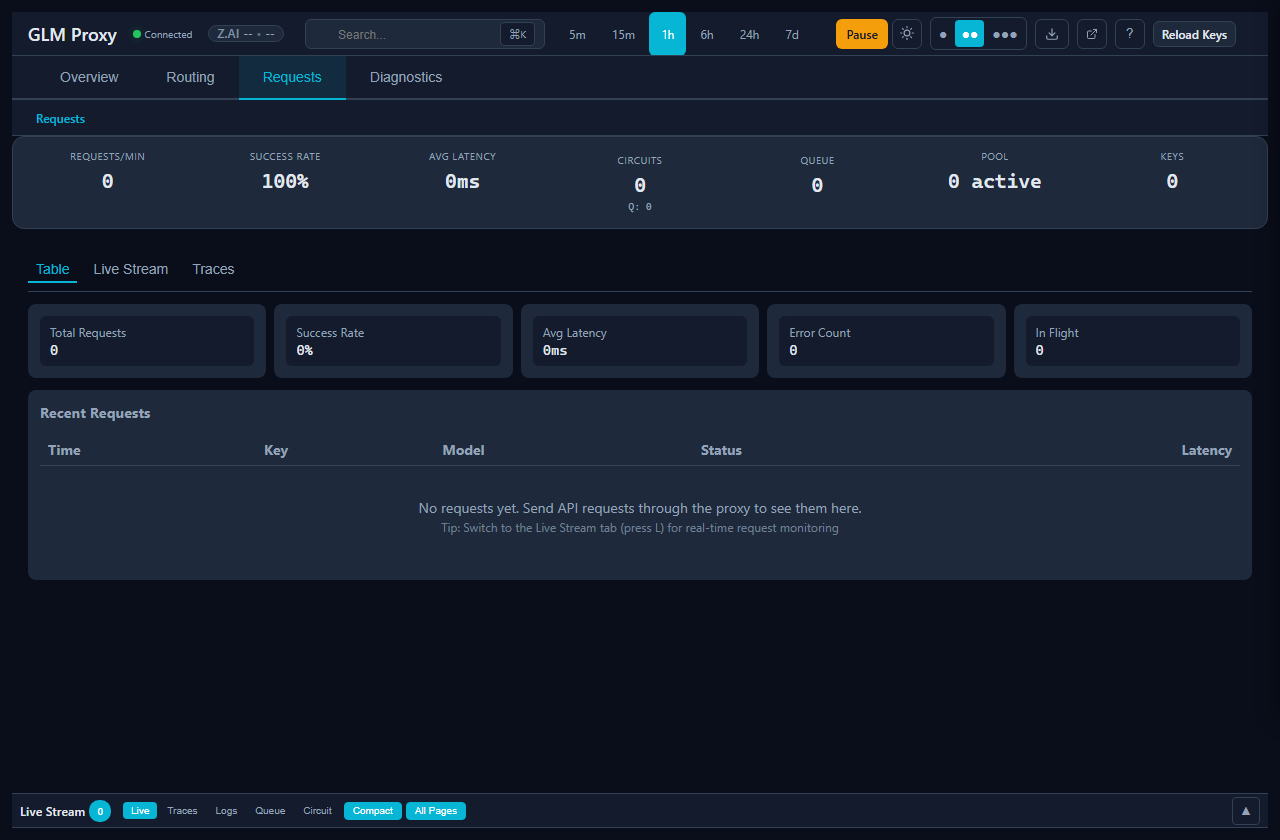
Trace Table - View individual request events:

Log Entries - Real-time event log:
Connection
Endpoint: GET /events or GET /requests/stream
Query Parameters:
types(optional): Comma-separated list of event types to subscribe to. Default:all- Valid types:
request,kpi,alert,all
- Valid types:
Example:
GET /events?types=request,kpi
Event Contract
Every SSE message follows this contract:
event: <eventType>
data: <JSON payload>
Standard Message Envelope
All event payloads include these fields:
| Field | Type | Description |
|---|---|---|
seq |
number | Monotonically increasing sequence number (global, per-broadcast) |
ts |
number | Unix timestamp in milliseconds when event was created |
schemaVersion |
number | Schema version for backward compatibility (currently 1) |
type |
string | Event type name (matches the event: line) |
Plus event-specific fields described below.
Sequence Number Semantics:
seqis a global counter incremented once per broadcast event- All clients subscribed to the same event type receive the same
seqvalue - The
connectedevent has its own seq (unique to that client’s connection) - Clients can detect missed events by checking
seq > lastSeq + 1 - Note: If you’re subscribed to a subset of event types, you’ll see gaps in seq (this is expected)
Event Types
connected
Sent immediately on connection. Includes recent requests for initial state hydration.
{
  "seq": 1,
  "ts": 1706380800000,
  "schemaVersion": 1,
  "type": "connected",
  "clientId": "sse-1706380800000-abc123xyz",
  "subscribedTypes": ["all"],
  "recentRequests": [
    { /* request object */ }
  ]
}
| Field | Type | Description |
|---|---|---|
clientId |
string | Unique identifier for this SSE connection |
subscribedTypes |
string[] | Event types this client is subscribed to |
recentRequests |
object[] | Last 50 requests for initial state |
request
Emitted for each proxied request completion. Critical event - clients that can’t keep up may be disconnected.
{
  "seq": 42,
  "ts": 1706380801234,
  "schemaVersion": 1,
  "type": "request",
  "requestId": "req-abc123",
  "keyIndex": 0,
  "keyPrefix": "sk-abc...",
  "status": 200,
  "latencyMs": 1234,
  "model": "claude-3-5-sonnet-20241022",
  "mappedModel": "glm-4-plus",
  "inputTokens": 1000,
  "outputTokens": 500,
  "cost": 0.0225,
  "costStatus": "calculated",
  "streaming": true,
  "retries": 0,
  "errorType": null,
  "timestamp": 1706380801234
}
| Field | Type | Description |
|---|---|---|
requestId |
string | Unique request identifier |
keyIndex |
number | Index of the API key used |
keyPrefix |
string | First 8 characters of the key |
status |
number | HTTP status code returned to client |
latencyMs |
number | Total request duration in milliseconds |
model |
string | Model requested by client |
mappedModel |
string|null | GLM model the request was mapped to |
inputTokens |
number|null | Input tokens used |
outputTokens |
number|null | Output tokens used |
cost |
number|null | Calculated cost in USD (null if unavailable) |
costStatus |
string | One of: calculated, unknown_model, no_tokens, unavailable |
streaming |
boolean | Whether this was a streaming request |
retries |
number | Number of retries attempted |
errorType |
string|null | Error classification if failed |
timestamp |
number | Request completion timestamp |
kpi
Periodic lightweight stats snapshot. Emitted every 30 seconds. Non-critical - may be dropped under backpressure.
{
  "seq": 100,
  "ts": 1706380830000,
  "schemaVersion": 1,
  "type": "kpi",
  "uptime": 3600000,
  "activeKeys": 3,
  "totalKeys": 5,
  "requests": 1234,
  "errors": 12,
  "activeConnections": 5,
  "sseClients": 2,
  "poolStatus": {
    "inCooldown": false,
    "cooldownRemainingMs": 0,
    "pool429Count": 0
  }
}
| Field | Type | Description |
|---|---|---|
uptime |
number | Proxy uptime in milliseconds |
activeKeys |
number | Number of healthy (CLOSED/HALF_OPEN) keys |
totalKeys |
number | Total configured keys |
requests |
number | Total requests processed |
errors |
number | Total errors |
activeConnections |
number | Current HTTP connections |
sseClients |
number | Connected SSE clients |
poolStatus |
object | Key pool rate limit state |
poolStatus.inCooldown |
boolean | Whether pool is in cooldown |
poolStatus.cooldownRemainingMs |
number | Milliseconds until cooldown ends |
poolStatus.pool429Count |
number | Count of pool-wide 429s |
alert
Budget or threshold alerts. Emitted when cost thresholds are exceeded.
{
  "seq": 150,
  "ts": 1706380900000,
  "schemaVersion": 1,
  "type": "alert",
  "alertType": "budget_warning",
  "severity": "warning",
  "message": "Daily budget 80% consumed",
  "details": {
    "period": "today",
    "current": 80.00,
    "limit": 100.00,
    "percentUsed": 80
  }
}
| Field | Type | Description |
|---|---|---|
alertType |
string | Alert classification |
severity |
string | One of: info, warning, critical |
message |
string | Human-readable alert message |
details |
object | Alert-specific details |
Heartbeat
The server sends comment-line pings every 15 seconds to keep the connection alive:
: ping 1706380815000
These are SSE comments (start with :) and are not JSON events.
Backpressure Handling
Performance: See Load Testing Guide for throughput optimization under high load.
The server implements backpressure to protect against slow clients:
- Non-critical events (
kpi): Silently dropped when client buffer is full - Critical events (
request): Client disconnected after 30 seconds of backpressure
Clients should:
- Process events quickly
- Track
seqnumbers to detect gaps - Reconnect and hydrate from
recentRequestsif gaps detected
Client Implementation
Recommended Pattern
const evtSource = new EventSource('/events?types=request,kpi');

let lastSeq = 0;

evtSource.addEventListener('connected', (e) => {
  const data = JSON.parse(e.data);
  // Hydrate initial state from recentRequests
  data.recentRequests.forEach(req => store.addRequest(req));
  lastSeq = data.seq;
});

evtSource.addEventListener('request', (e) => {
  const data = JSON.parse(e.data);
  // Check for gaps
  if (data.seq > lastSeq + 1) {
    console.warn(`Gap detected: ${lastSeq} -> ${data.seq}`);
    // Consider refetching state
  }
  lastSeq = data.seq;
  store.addRequest(data);
});

evtSource.addEventListener('kpi', (e) => {
  const data = JSON.parse(e.data);
  store.updateKPI(data);
});

evtSource.onerror = () => {
  // Reconnect logic with exponential backoff
};
Gap Recovery
When a sequence gap is detected:
- Continue processing new events
- Fetch
/statsfor current aggregate state - Fetch
/requests?limit=100for recent request history - Merge with local state
Schema Versioning
The schemaVersion field enables backward-compatible evolution:
- Version 1 (current): Initial schema as documented above
- Future versions will increment this number
- Clients should handle unknown fields gracefully
Related Endpoints
| Endpoint | Description |
|---|---|
GET /stats |
Full stats snapshot (for gap recovery) |
GET /requests |
Recent requests list (for gap recovery) |
GET /stats/models |
Per-model statistics |
GET /health |
Health check |
Reference: See Metrics Reference for all available
/statsand/metricsfields.